

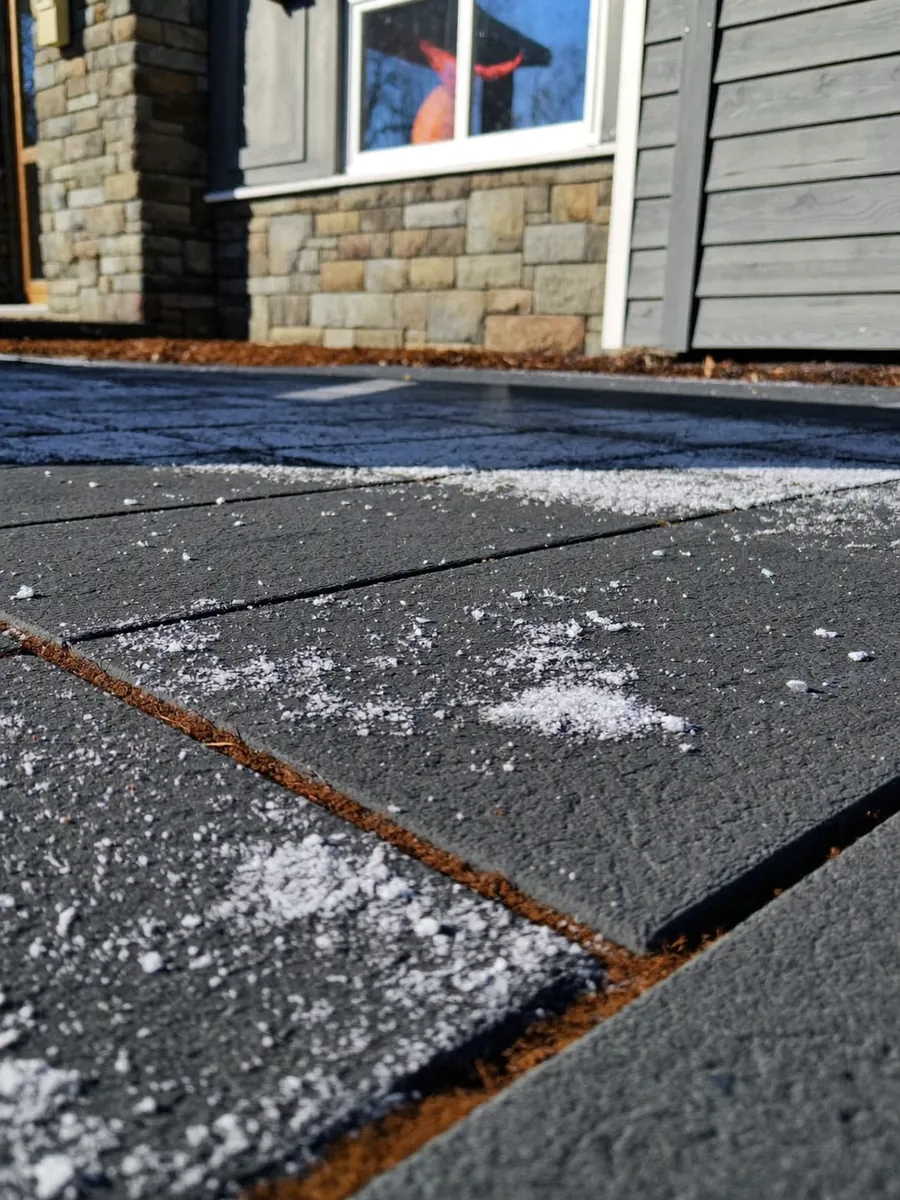
Yes, you can use salt on interlock, as long as you use it sparingly and clear away the excess. The Concrete Masonry and Hardscapes Association (CMHA) says rock salt is the least damaging de-icer for concrete materials and should be used whenever possible. CMHA is a trade body whose members include paver makers, formed from the Interlocking Concrete Pavement Institute and the National Concrete Masonry Association. The risks to watch in a Durham Region winter are too much product, the wrong product, and metal tools scraping the surface.
What does salt on interlock actually do?
Salt on interlock is something Canadian pavers are tested for. Concrete pavers made in Canada must meet CSA A231.2, which tests freeze-thaw durability with samples immersed in a 3% saline solution, down to -15°C. CMHA also says a paver’s high density limits how much de-icer can get in.
That does not make salt harmless. Leave too much on the surface and it builds up, which is why CMHA says to clear away the excess. Winters are long in Durham Region: Environment Canada’s 1991 to 2020 normals for Oshawa show 101.7 cm of snow a year and 130 days with a low of 0°C or colder.
Which de-icer should you use on pavers?
For salt on interlock, start with plain rock salt, then check the care guide for your paver brand, because the advice differs. Here is how CMHA’s de-icer guidance and the care guide from Permacon, a paver maker, compare:
- Rock salt (sodium chloride): CMHA’s first choice, and the product Permacon recommends.
- Calcium chloride: the two disagree. CMHA says to consider careful use if you need something quicker. Permacon prohibits it on its products. Check your brand’s rule first.
- Magnesium chloride: CMHA does not recommend it, because it can chemically degrade all types of concrete. Permacon prohibits it.
- CMA (calcium magnesium acetate): CMHA does not recommend it, for the same reason.
- A product you cannot identify: If you do not know what is in it, Permacon suggests you do not use it.
Rock salt also works less well in deep cold. CMHA’s chart puts its lowest practical temperature at about -9°C, and Conservation Ontario’s guide says -7°C. Oshawa’s normal January low is -8.9°C, so salt can be slow on a cold morning. Sand gives you grip in the meantime. Permacon says to use fine-grained sand, because gravel can scratch, and CMHA and Permacon both say to keep sand off permeable pavers.
A few habits help with any product:
- Clear the snow first. CMHA says de-icers should not replace snow removal.
- Use only what you need, and keep it off plants and metal.
- Once the ice loosens, shovel away the slush and leftover salt.
Using less salt on interlock also helps local creeks. The Toronto and Region Conservation Authority says chloride from road salt is rising in the region’s streams. It reports chloride regularly over the threshold for aquatic life in the stretches of Carruthers Creek with urban influences. That creek empties into Lake Ontario at Ajax.
Is salt safe on flagstone and natural stone?
It depends on the stone. The Natural Stone Institute says many stones, especially limestones, are vulnerable to snow melting chemicals, particularly salt. Salty water enters the pores and, as it evaporates, the salt crystallizes. That pressure can flake off the surface. The Institute names limestone and travertine as the two stones most commonly affected.
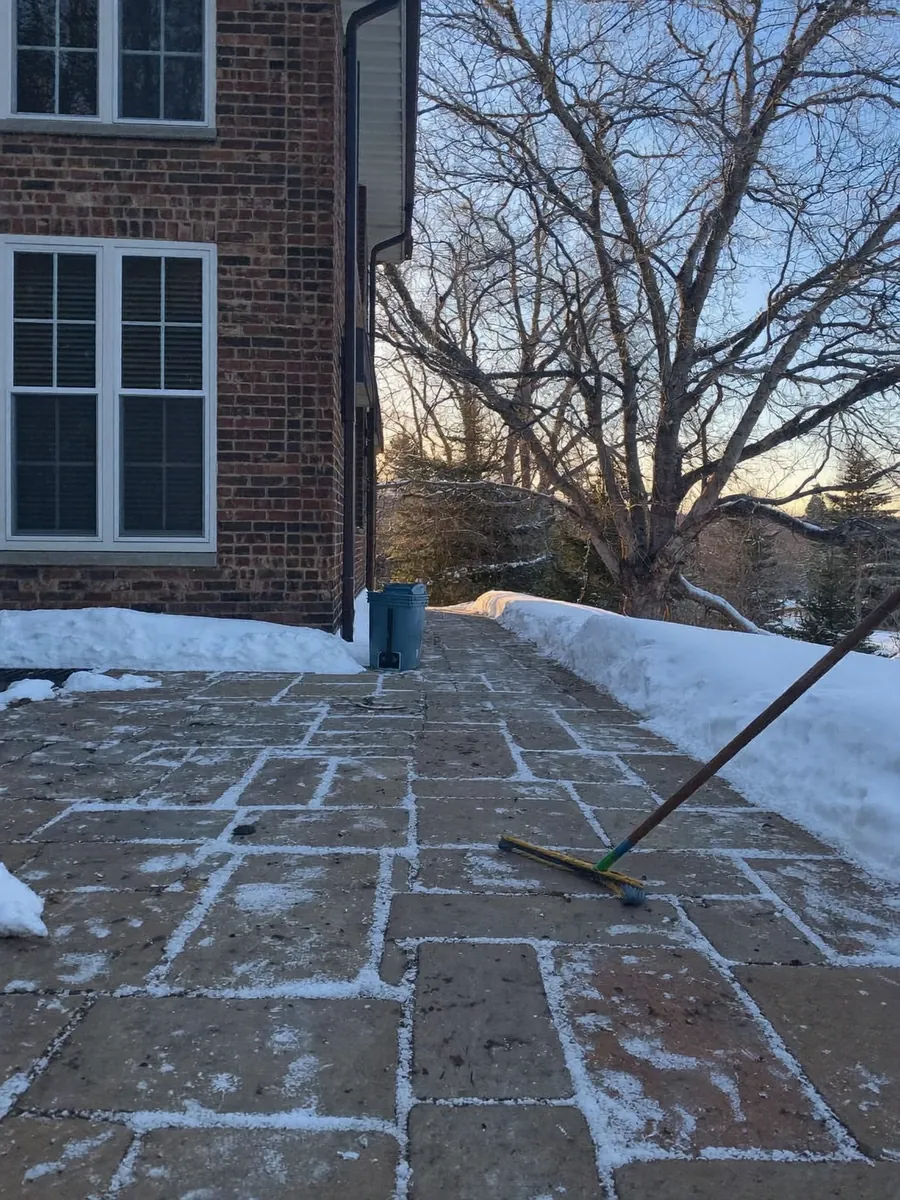
So find out what your stone is before you salt it. Ask whoever installed it, or ask us. For porous masonry stoops, the New York Landmarks Conservancy, a heritage group in New York, advises: shovel first, mix de-icer with sand, use it sparingly in high foot traffic areas only, and keep it away from the base of the building, since it can damage walls as well as steps.
How should you clear snow off interlock?
Tools leave their own marks, and both CMHA’s maintenance note and Permacon’s guide give advice on equipment:
- Use a plastic shovel. Permacon recommends plastic shovels without metal blades. CMHA says scratches are more noticeable on textured or polished pavers.
- Work on a diagonal to the joints. CMHA says it makes clearing easier and helps avoid catching paver edges.
- Check the shoes on your snowblower. CMHA says they hold the blade just above the surface, need adjusting as they wear, and can leave metal filings that turn into rust stains.
- Tell your plow operator it is interlock. Permacon recommends an adjustable depth skate and a snow guard blade.
- Keep the piles off the pavers. CMHA says not to store snow, ice and salt on concrete paver pavement. Pile it where the meltwater drains away from your walkway, so it does not refreeze.
- Do not chip at stubborn ice. Treat it, let it loosen, then clear it. Metal tools can scratch the surface.
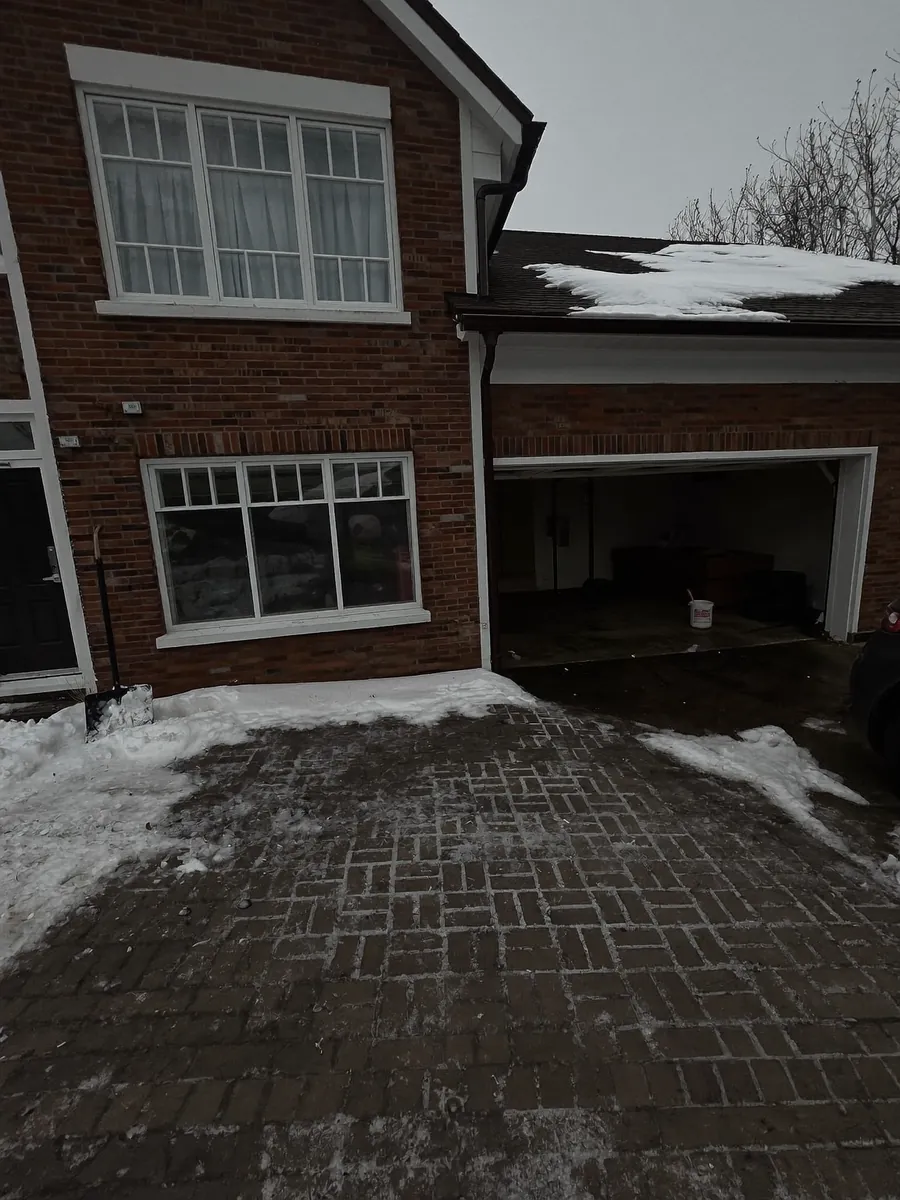
Fix raised pavers before the first snowfall. CMHA says to repair heaved or lifted units with more than 1/8 in. (3 mm) of height difference before winter, since plowing over them can chip the edges. If you would rather hand all of this to someone else, we offer snow removal across Durham Region.
What is frost heave, and should you worry?
Frost heave happens when moisture in the ground freezes and expands, pushing up what sits above it. The explanatory notes to Ontario’s Building Code, written about footings, name clay and silt as frost-susceptible soils. They also explain why it keeps growing: water moves through the soil toward the ice as it forms, freezes onto it, and the cycle repeats.
The time to judge it is after the thaw. A section that stays raised, or a dip that holds water, can point to a problem below the surface: a thin base, poor compaction or water with nowhere to go. That is a job for proper repair rather than more joint sand, and it is why we start every driveway and flagstone patio we build with proper excavation and a compacted base.
What should you check in spring?
Once the snow is gone, leftover salt on interlock should come off. Then check the rest:
- Rinse the salt off your interlock. Permacon says to hold a garden hose at a 30-degree angle, perpendicular to the joints, so polymeric sand stays put. For stubborn salt, it recommends a scrub or bristle brush, not a wire brush.
- Sweep up winter sand. CMHA says sand left year after year wears the surface.
- Check the edging. Permacon says to confirm the edging held, reset shifted pavers and replace damaged ones.
- Look at the joints. If polymeric sand has failed, Permacon says to remove at least 1 1/2 in. (about 38 mm) of the old sand and install new, typically in summer.
- Watch for low spots. Note raised or sunken areas, and places where water sits after rain.
- Look at your steps and borders. Slipped stone steps can often be reset.
Found a spot that needs attention? Winter is a good time to plan the fix, because the schedule fills in spring and summer. Ask for a free on-site quote and we will take a look.